Well, the great idea that was supposed to be this blog has been difficult to tend to. Publication deadlines, teaching, and life and general have pulled me away from the original intentions of this blog. I'm still not sure exactly how I want to use this platform in the future. Frost & Sullivan wants us to blog more, which is fine and might be the approach I will take. Its just challenging because its not like I'm given any hours for blogging, its just suppose to happen. Like the vast majority of everything at this job, its just suppose to happen.
Also, the notion of using this blog for teaching purposes turned out to be more difficult than I had thought originally. The time it takes to upload and then trying to get your students to REMEMBER to check the blog, write a response and comment, just wasn't working. If I use that format in the future, I will work with WebCT or one of the systems in place at the school and then either crosspost, post the best responses or something.
In my class, we've been talking about careers and its caused me to do some reflection. I've had a lot of interested and difficult career experiences in my life and maybe I can pass along some of my wisdom (or lack of foresight) to someone else. Please enjoy Career Advice #1!
Having credit stolen on a major project that moves on to be a success is a frustrating experience that does take time to get over. You have to learn to let go.
Here's the short version:
I worked on a large project, was lied to about future employment and was never credited with my rather large significant contribution.
This thing has actually had quite a bit of success and has become a national program. And of course I'm no longer at the institution and you'll NEVER see my name on it.
Its really brought me down over the last two years. I sweated blood for that damn thing, burned myself out, let my classes slide, all for that cause and then to feel like I got nothing for it was definitely a slap in the face. So here I am, two years later, and you know I'm realizing more and more that nothing is going to change. There will never be an apology. The people who run the program are going to keep building the prestige and success of the program (because they get paid to). No one cares about what Rob did for that thing and that's just how it is.
And its one thing to talk about acceptance, forgiveness and all the Zen concepts in the world, but there comes a point where you have to just fight yourself out of the self pity and keep going. My career now doesn't involve working with my old employer. They have no effect on me whatsoever. I see my old employer through our local ISSA meetings and that's it.
I'm see a lot of working professionals who let this stuff ruin them for life. They get looked over for a promotion, credit is stolen, whatever, and they just don't let it go. It continues to affect their life, their disposition towards others, their whole life. Life's too short. And burning yourself out over wanting an apology or explanation doesn't help.
I have had several experiences in my life where I have made people mad at me without even knowing the cause. I have had people fuming and furious with me without ever knowing why. Was it justified? Occasionally. Sometimes I had done something that offended someone without even knowing it. Most of the time though, I didn't even know I had done anything wrong at all. Most people are like that.
So, what's the moral of this long ramble? Take the stabs, outright lies, and overlooks as gracefully as possible. That doesn't mean to become a doormat, but realize when the intent is malicious or simply ignorant and decide your course of action from there. It doesn't mean to torture yourself with a bad environment. It just means take what happen for what it was and move on from there.
Tuesday, April 17, 2007

Thursday, February 01, 2007
Ethereal has changed its name
http://www.wireshark.org/
I just discovered that the Ethereal program I have used and loved for so long now goes by the name Wireshark. I would encourage everyone to download and play with Wireshark to help understand the OSI model and network communications better. We will do a lot with this program throughout the semester.
On a related note, this is a great blog that goes through tracing network communications, has sample dumps to put in Wireshark to look at, and even talks about spyware infections.
http://www.chrissanders.org/?p=47
I just discovered that the Ethereal program I have used and loved for so long now goes by the name Wireshark. I would encourage everyone to download and play with Wireshark to help understand the OSI model and network communications better. We will do a lot with this program throughout the semester.
On a related note, this is a great blog that goes through tracing network communications, has sample dumps to put in Wireshark to look at, and even talks about spyware infections.
http://www.chrissanders.org/?p=47
Tuesday, January 30, 2007
In Class Exercise #1
Get into groups of two.
Tell me a little bit about what you believe to be the greatest computer security risk to students at UIW. Describe IN DETAIL based on either your own experience or the experience of friends. Include the reasons behind why this risk exists, what technologies could be implemented to help, what education could be provided to students, etc. This can be a physical risk (losing a laptop, shoulder surfing), network risk, lab risk, etc.
Think of risky behaviors you have seen on campus. Think of the dorms, the labs and other locations on campus.
We will discuss this at the end of class. Could dovetail very easily into an extra credit article for a group.
Tell me a little bit about what you believe to be the greatest computer security risk to students at UIW. Describe IN DETAIL based on either your own experience or the experience of friends. Include the reasons behind why this risk exists, what technologies could be implemented to help, what education could be provided to students, etc. This can be a physical risk (losing a laptop, shoulder surfing), network risk, lab risk, etc.
Think of risky behaviors you have seen on campus. Think of the dorms, the labs and other locations on campus.
We will discuss this at the end of class. Could dovetail very easily into an extra credit article for a group.
The OSI Model and Security
Reference article on OSI and security
This is a sample chapter out of a book that is a good reference for the OSI model in general (which you need to know backwards, forwards and sideways) and some interesting discussion about how security and the layers interact.
I want you to pick one of the layers and post an answer to the following questions:
1) Which layer did you pick?
2) Why do you feel this layer poses the greatest security risk?
This is a sample chapter out of a book that is a good reference for the OSI model in general (which you need to know backwards, forwards and sideways) and some interesting discussion about how security and the layers interact.
I want you to pick one of the layers and post an answer to the following questions:
1) Which layer did you pick?
2) Why do you feel this layer poses the greatest security risk?
Wednesday, January 17, 2007
For my class...or anyone else who wants to comment :-)
I commented to a reporter for this article back in July. I would like for you to research the issue and provide me a few paragraphs about your thoughts. Answer the questions
1) What was the problem (detail)?
2) Why was this a big issue for MySpace?
3) Who do you think is to blame? Microsoft, MySpace, or Users and why?
4) How can colleges (which have a high population of MySpace users) help control/educate their users? Should MySpace be blocked?
I commented to a reporter for this article back in July. I would like for you to research the issue and provide me a few paragraphs about your thoughts. Answer the questions
1) What was the problem (detail)?
2) Why was this a big issue for MySpace?
3) Who do you think is to blame? Microsoft, MySpace, or Users and why?
4) How can colleges (which have a high population of MySpace users) help control/educate their users? Should MySpace be blocked?
Tuesday, November 28, 2006
And then Ballmer spoke and the Linux community became afraid...
(Article Here)
Quite a firestorm this thing has become. Here I thought that the Novell partnership was straightforward, that MS was finally doing something smart and that all of us would actually reap the benefits of Linux running Windows. Then Ballmer opened his mouth and all Hell hath broken loose...
If you read the original comments(found here) I think there are some interesting points that Ballmer is making and that its not all as alarmist as one might think.
My two cents:
Ballmer talks about interoperability first then makes the comment about Novell having paid MS for their intellectual property. He also talks about the way GPL is structured and that MS has to get money for their intellectual property.
The assumption is that he's talking about Linux stealing MS' IP, but I don't think this is even what he was talking about. Read the paragraph before the comments and what he's saying. I believe he means that MS can't be fully interoperable with Linux as is because they're not about to make any part of Windows open to GPL.
MS might have a real point here. I'm not a Linux expert, but one has to ask: are there pieces of Linux that deal with Windows interoperability that were reversed engineered and distributed with the kernel? Are there any services dealing with directories, printing, or networking that were maybe MS proprietary but easily decoded?
So, in order to have "true" interoperability, one of the Linux vendors had to cut a deal with MS. So Novell does the deed.
Moving forward SUSE is going to have interoperability with Windows. And you know what will happen - someone will release it to the rest of the open source community (which is what the open source community does well) and then - THEN you have the problems that Ballmer was discussing with the liability in the datacenter when some admin compiles himself a new Windows Interop package and runs it on a "non compliant" Linux.
Once something like that happens, MS can do nothing about it. Its one of the classic drawbacks of open source - who do you sue when things go wrong? Microsoft wants to get working on/with Linux and knows they can't make money off of it if they open it up, so they've taken this approach: get someone to pony up for it, and once its released to the open source communtiy, sue anyone who runs Windows on an unapproved Linux. I'm actually impressed with MS' foresight in this one. I'm not even sure that the Linux community sees it just yet.
Its definately going to be interesting to see what happens.
(Article Here)
Quite a firestorm this thing has become. Here I thought that the Novell partnership was straightforward, that MS was finally doing something smart and that all of us would actually reap the benefits of Linux running Windows. Then Ballmer opened his mouth and all Hell hath broken loose...
If you read the original comments(found here) I think there are some interesting points that Ballmer is making and that its not all as alarmist as one might think.
My two cents:
Ballmer talks about interoperability first then makes the comment about Novell having paid MS for their intellectual property. He also talks about the way GPL is structured and that MS has to get money for their intellectual property.
The assumption is that he's talking about Linux stealing MS' IP, but I don't think this is even what he was talking about. Read the paragraph before the comments and what he's saying. I believe he means that MS can't be fully interoperable with Linux as is because they're not about to make any part of Windows open to GPL.
MS might have a real point here. I'm not a Linux expert, but one has to ask: are there pieces of Linux that deal with Windows interoperability that were reversed engineered and distributed with the kernel? Are there any services dealing with directories, printing, or networking that were maybe MS proprietary but easily decoded?
So, in order to have "true" interoperability, one of the Linux vendors had to cut a deal with MS. So Novell does the deed.
Moving forward SUSE is going to have interoperability with Windows. And you know what will happen - someone will release it to the rest of the open source community (which is what the open source community does well) and then - THEN you have the problems that Ballmer was discussing with the liability in the datacenter when some admin compiles himself a new Windows Interop package and runs it on a "non compliant" Linux.
Once something like that happens, MS can do nothing about it. Its one of the classic drawbacks of open source - who do you sue when things go wrong? Microsoft wants to get working on/with Linux and knows they can't make money off of it if they open it up, so they've taken this approach: get someone to pony up for it, and once its released to the open source communtiy, sue anyone who runs Windows on an unapproved Linux. I'm actually impressed with MS' foresight in this one. I'm not even sure that the Linux community sees it just yet.
Its definately going to be interesting to see what happens.
Friday, November 10, 2006
Tell me something I don't know -
End User's Don't Get Security.
An interesting study, and I agree for the most part. In fact I see this everyday. Actually, employees not getting security keeps me in a job. However, is it really the employees fault? I have seen firsthand the severe disconnect that exists between security and management. As much as everyone wants to point their fingers at the "bozo" employee (I've heard an IT director call his users that, and let's just say that considering some of his security practices I'm not sure who should have been wearing the red nose...another story for another time) one has to be willing to point the finger squarely at management. I'm not just talking about spending money on security, lots of organizations are doing that, but its the failure to embrace security at a operations level, the failure to have processes in place to deal with exceptions that is causing many employees to ignore security.
Case in point:
A good friend of mine works as a Music Therapist at a hospital here. She works hard and is responsible for seeing patients just as any social worker, nurse, or doctor. However, her position is unique to the hospital. She needs access to music sites, she gets grants to purchase music, she has a legitimate reason to look at sites that the hospital has deemed inappropriate for other employees. She also uses a CD burner on a regular basis, typically a "controlled" device at the hospital.
Many would consider that lack of access a good thing, but here's the caveat - there is no process in place for her to go get this modified. She has had to jump through hoops, make continued calls to help desk, and still has impediments to getting her job done on a daily basis. The solution for her is to have me download music, files, etc. and put them on a zip drive (which aren't locked down, but which is another potential security risk).
The point is this - in her environment, security is an impediment to her job. She is encouraged to go around the security in the environment, not for some self serving purpose, but in order to get her job done. She is expected to do her job just like any other professional, she has a boss, and she doesn't have hours a day to waste waiting on the help desk (she deals with some very ill patients).
Security vendors have focused on very effective technologies. There is still a great deal of FUD used to sell products, whether its about hackers or regulators, and unfortunately the end user suffer. When people cannot get their job done because of security, that is a problem. It leads to lower productivity and lower moral.
I don't have the answer. Its a combination of vendor products' design and corporate policy. However, I will say that at the end of the day I don't blame the employee for "not getting security" when they are trying to do jobs with the added frustration of security and time that of course is unaccounted for.
I am very passionate about this topic, you will hear more from me on it.
End User's Don't Get Security.
An interesting study, and I agree for the most part. In fact I see this everyday. Actually, employees not getting security keeps me in a job. However, is it really the employees fault? I have seen firsthand the severe disconnect that exists between security and management. As much as everyone wants to point their fingers at the "bozo" employee (I've heard an IT director call his users that, and let's just say that considering some of his security practices I'm not sure who should have been wearing the red nose...another story for another time) one has to be willing to point the finger squarely at management. I'm not just talking about spending money on security, lots of organizations are doing that, but its the failure to embrace security at a operations level, the failure to have processes in place to deal with exceptions that is causing many employees to ignore security.
Case in point:
A good friend of mine works as a Music Therapist at a hospital here. She works hard and is responsible for seeing patients just as any social worker, nurse, or doctor. However, her position is unique to the hospital. She needs access to music sites, she gets grants to purchase music, she has a legitimate reason to look at sites that the hospital has deemed inappropriate for other employees. She also uses a CD burner on a regular basis, typically a "controlled" device at the hospital.
Many would consider that lack of access a good thing, but here's the caveat - there is no process in place for her to go get this modified. She has had to jump through hoops, make continued calls to help desk, and still has impediments to getting her job done on a daily basis. The solution for her is to have me download music, files, etc. and put them on a zip drive (which aren't locked down, but which is another potential security risk).
The point is this - in her environment, security is an impediment to her job. She is encouraged to go around the security in the environment, not for some self serving purpose, but in order to get her job done. She is expected to do her job just like any other professional, she has a boss, and she doesn't have hours a day to waste waiting on the help desk (she deals with some very ill patients).
Security vendors have focused on very effective technologies. There is still a great deal of FUD used to sell products, whether its about hackers or regulators, and unfortunately the end user suffer. When people cannot get their job done because of security, that is a problem. It leads to lower productivity and lower moral.
I don't have the answer. Its a combination of vendor products' design and corporate policy. However, I will say that at the end of the day I don't blame the employee for "not getting security" when they are trying to do jobs with the added frustration of security and time that of course is unaccounted for.
I am very passionate about this topic, you will hear more from me on it.
Thursday, November 09, 2006
Going through Slashdot today, I stumbled upon this blog article:
http://www.linuxjournal.com/node/1000121
Fanatical Linux users at their best. I like Linux, don't get me wrong, but everything about this deal that I have read is about creating a distro of Linux that Microsoft will run with/on/whatever.
So, Microsoft wants to make a deal with Novell to create a distro of SUSE that runs BOTH Microsoft and Linux and yet the call from the SUSE folks is to dump SUSE! Down with SUSE! Abandon ship!
I understand that Novell getting in bed with Microsoft is a serious slap in the face to SUSE users. However, I wish Linux users would wake up and realize that not interoperating with Microsoft is THE single stumbling block to mainstream Linux acceptance. Look at Apple. I don't have numbers in front of me, but all indications are that Apple is starting to see a surge in new sales due to the dual-boot option. Why can't the Linux community understand that they are NOT going to get Linux on the desktop until this is resolved.
I commend Novell for yet again pulling a rabit out of it's [insert hat or body part here] and still going.
http://www.linuxjournal.com/node/1000121
Fanatical Linux users at their best. I like Linux, don't get me wrong, but everything about this deal that I have read is about creating a distro of Linux that Microsoft will run with/on/whatever.
So, Microsoft wants to make a deal with Novell to create a distro of SUSE that runs BOTH Microsoft and Linux and yet the call from the SUSE folks is to dump SUSE! Down with SUSE! Abandon ship!
I understand that Novell getting in bed with Microsoft is a serious slap in the face to SUSE users. However, I wish Linux users would wake up and realize that not interoperating with Microsoft is THE single stumbling block to mainstream Linux acceptance. Look at Apple. I don't have numbers in front of me, but all indications are that Apple is starting to see a surge in new sales due to the dual-boot option. Why can't the Linux community understand that they are NOT going to get Linux on the desktop until this is resolved.
I commend Novell for yet again pulling a rabit out of it's [insert hat or body part here] and still going.
Tuesday, November 07, 2006
We're going to give Blogger a shot. Though I've used LiveJournal in the past and as more of a personal sounding board, I want a blog that is not going to be so tied to my personal life, friends, etc. I want more of a working blog where I can post about Information Security, teaching, and things that I hope reach a wider audience than just my few friends.
And to start this wonderful day, please see the following comics from two of my daily comic stops:

My daily readings include Dilbert, Foxtrot, Zits, Shoe, Calvin and Hobbes (yes, I realize that Calvin is just re-runs, but I still read it), and PvPOnline (a great web comic). Occassionally, I'll pop over to Garfield, but that one is a little hit and miss in my book.
I think there is something to be said for taking a little time out of your busy day for a couple laughs at some great comics.
And to start this wonderful day, please see the following comics from two of my daily comic stops:
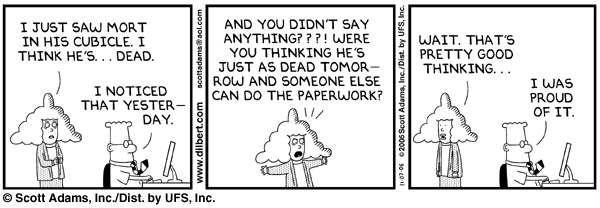

My daily readings include Dilbert, Foxtrot, Zits, Shoe, Calvin and Hobbes (yes, I realize that Calvin is just re-runs, but I still read it), and PvPOnline (a great web comic). Occassionally, I'll pop over to Garfield, but that one is a little hit and miss in my book.
I think there is something to be said for taking a little time out of your busy day for a couple laughs at some great comics.
Subscribe to:
Posts (Atom)
